

Following a vision of global harmony thanks to Pokemon Go, it's undeniable that the monster collecting series is about as mainstream gaming titles in existence. The iconic Pikachu is every bit as identifiable as Mickey Mouse, perhaps even more. The continued frenzy surrounding card prices ensures near-daily Pokémon news stories. It would be difficult to find a pocket monster game that failed to move at least a couple million copies. Remarkably, fan-made Pokémon games achieve popularity every year.
Yet despite that ubiquity and fame, some Pokémon games that are totally underappreciated. These are titles that failed to receive their fair shake, or were buried by the excitement of the core series. These are Pokémon games released on doomed consoles or services, or were pioneering attempts onto different formats. Frequently, they are Pokémon games that might have flourished if they had received follow-ups or modern remakes. With these criteria in mind, we won't be offering yet another recommendation for Pokémon Conquest or the Pokemon Mystery Dungeon series. We're digging deep.
Still, these might be these Pokémon games. So, before rearranging your glasses and writing 'Well,' let us just agree that these are Pokémon games for those possessing discerning palates, shall we?
Pokemon Ranch: The Cozy Precursor
Too many Pokémon games focus on the battling aspect of the series, and not nearly enough of them highlight the ordinary realities that would come with owning a companion. Admittedly, there are minor mechanics like these in modern games—players may pet, and feed your monsters in camps. But I am longing for a Pokémon game more in the style of Nintendogs or The Sims.
My Pokemon Ranch (2008) for the Nintendo Wii isn't it. The digital-only title is best seen as the antecedent to Pokémon Home; that is, as a repository to hold monsters from various titles. Reviews from its launch said Ranch was a bad if not outright hideous game. I'm not here to dispute these claims, but it behooves me to say Ranch might be the nearest we've come to a slice-of-life Pokémon game.
True to its title, the game takes place on a ranch where your Mii avatars—imagine this—just relax with your Pokémon pals. The interactions with Pokémon were basic, and a significant part of the appeal was watching what your monsters might do when not forced into cockfighting. In a just world, Pokémon Ranch would have been the start of a wonderful franchise built on the simple pleasures of living your life with a tiny companion. But since The Pokémon Company can charge a subscription for Pokémon Home now, I'm guessing we will not get a Pokémon Ranch game realized to its complete potential. I'd say 'save us, Pokémon Pokopia!' but I also know that the upcoming Switch exclusive is just as much a puzzle game as it is a life simulation.
Ranch came out long before Stardew Valley kicked off the enduring trend of comfort gaming. It was before the proliferation of idle games, and the video playthrough normalization of viewing games you aren't playing. Many never realized that Ranch's concept to watch your creatures as much as you play with them wasn't to hide a lack of substance. In truth, Ranch's attention to detail was so remarkable, there's a live stream focused on running the game continuously. The individual who operates the channel states that, after almost twenty years of playing the game, he even now has not encountered everything that is in it. Recognition for Pokémon Ranch: no one knew what to do with you in 2008.
Pokémon Duel: The Tactical Tabletop Game Lost
Are you aware that Pokémon once had an licensed board game with action figures? Pokemon Duel was the 2016 attempt to adapt the tabletop experience in a more accessible format. Duel was also, sadly, one of Pokémon's first ventures into the world of free-to-play mobile gaming. Duel had the trappings of a gacha game where players could pay to win—and there was incentive to do so, given the slow progression for new figures.
These poor design choices obfuscated a sad truth: Pokémon Duel was an excellent strategy game with Duel anymore. "Words cannot describe how much I loved and miss this game," a YouTube comment states, years after Duel's servers were pulled. "Truly I think this game was better than TCG Pocket in terms of depth, accessibility, game design, and features in general," another commenter wrote. "I truly believe if it came out now people would be playing it more than GO and Pocket together."
Unfortunately, Duel's early release was plagued with server issues. Technical problems, alongside Duel's scummy monetization model, gave people few incentives to return. If, by some miracle, The Pokémon Company chose to resurrect this franchise, it's unclear things would end better. The unique board structure made for a fantastic tactical experience for the handful of players who played Duel, but that board is also a intimidating eyesore.
Pokemon: Magikarp Jump: The Silly Experiment
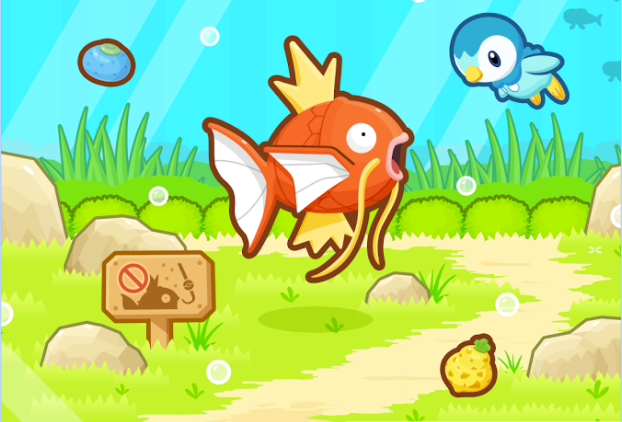
Man, why don't more Pokémon games relax a little and have some enjoyment? Magikarp Jump (2017) was a rare instance of The Pokémon Company approving a game with a concept so silly, it was bordering on internet meme. And when we're dealing with a franchise where trainers venture forth with a team of ineffective monsters who literally can't do anything, it's surprising we don't have more Pokémon games that poke fun at themselves.
In Magikarp Jump, the player is tasked with raising the best possible version of the notorious fish. I'm not talking about a Magikarp that can win battles. These are 'karp raised to enter competitions to see who can flop the highest. I'm not a fan is how Magikarp Jump, like many phone games, requires the player to pause before they can improve their Magikarp further. But it is evident throughout the experience that the developers loved and understood the fan culture around Magikarp.
Nowhere was this more evident than in Jump's brutal random events, where your Magikarp was just as likely to raise its stats as it was to get snatched by a Pidgeotto. Apart from the clever dialogue, Magikarp Jump also tried out other things one might wish the core series would do, like offering a wide variety of the same type of monster. It's understood it's not practical for any Pokémon game to have dozens of variations for a compendium of over a thousand creatures, as Magikarp Jump does... but we can hope.
Magikarp Jump was not a especially complex or deep game, but the kernels of genius were there. Sharply written events with unpredictable results that permanently influence how you can raise a pet also describe the excellent Mewgenics. And I'm just saying: Mewgenics will likely be in the running when Game of the Year season rolls around.
With dozens of mainline entries and derivative titles, chances are that I didn't mention that particular Pokémon game you absolutely adore but argue that not nearly enough people played. I know that some people look back on games like Pokemon Ranger or Pokemon Pinball fondly despite argu

